
United States · Diversity Immigrant Visa
DV Lottery 2027 — the Green Card Lottery explained
Everything you need to enter the US Diversity Visa 2027 programme correctly: eligibility, photo requirements, the step-by-step application, selection odds, timelines, scams to avoid and what happens after you are selected.

What the DV Lottery 2027 actually is
The Diversity Immigrant Visa Program — known worldwide as the Green Card Lottery — is the only route to United States permanent residence that does not require an employer, an American relative, or an investment. Congress created it to keep immigration flows diverse: each year up to 55,000 immigrant visas are set aside for nationals of countries that have sent relatively few immigrants to the US over the previous five years. The DV Lottery 2027 round, formally DV-2027, follows the same structure as previous years, and entries are accepted only through the official Department of State electronic entry form during a registration window that normally opens in early October and closes about a month later.
Two things make the US Diversity Visa 2027 unusual. First, it is free — the government charges nothing to submit an entry, and it never will. Second, it is genuinely random within each geographic region: a farm worker in Nepal and a software engineer in Algeria have exactly the same chance of being drawn. What is not random is whether your entry survives scrutiny. A significant share of selected entrants are ultimately refused because their entry contained an error, their photo did not meet specification, or they could not document the education or work experience they claimed. That is the part you control, and it is what this guide is about.
Selection is not the finish line. Being selected gives you the right to apply for an immigrant visa, and because the Department of State selects more entrants than there are visas available, cases are processed in rank order until the annual quota is exhausted at the end of the fiscal year. Entrants who move quickly, submit a clean DS-260, and arrive at the interview with complete documentation are the ones who convert selection into a green card. Entrants who wait, or who discover a missing civil document in month eleven, often run out of time.
Green Card Lottery eligibility: the two tests
DV Lottery requirements come down to two independent tests. You must pass both.
1. The country-of-birth test
Eligibility is determined by your country of birth, not your citizenship or your country of residence. Nationals of countries that have sent more than 50,000 immigrants to the US in the previous five years are excluded, and that exclusion list changes from year to year — countries such as India, China (mainland-born), Mexico, the Philippines, Nigeria, Brazil, Canada, the United Kingdom (except Northern Ireland), Bangladesh, Pakistan, Haiti, the Dominican Republic, Colombia, El Salvador, Honduras, Jamaica, South Korea, Venezuela and Vietnam have appeared on recent exclusion lists. Always confirm the DV-2027 list in the official instructions before you conclude you are ineligible.
If your country of birth is excluded, you may still qualify through two cross-chargeability routes: you can be charged to your spouse's country of birth if you were both born in eligible/ineligible pairs and will both immigrate together, or to a parent's country of birth if neither parent was born in, or a resident of, your country of birth at the time you were born. These are legitimate, frequently used provisions — but they must be declared correctly on the entry form, because a mis-declared chargeability is treated as a false claim.
2. The education or work-experience test
You must have either a completed high-school education — meaning a formal course of elementary and secondary education comparable to a full twelve-year US curriculum, evidenced by a diploma or certificate — or two years of work experience within the past five years in an occupation that requires at least two years of training or experience to perform. The occupation must qualify under the Department of Labor's O*NET classification at Job Zone 4 or 5 with an SVP rating of 7.0 or above. Equivalency courses, vocational certificates and adult-education programmes usually do not satisfy the education test, which is why the work-experience route matters: many skilled tradespeople, nurses, technicians and administrators qualify on experience even when their schooling was interrupted.
Neither test is checked when you submit your entry. Both are checked at the interview, with documents. This is precisely why so many selected entrants are refused — they entered on an optimistic reading of their own qualifications and could not prove it eighteen months later.
Not sure you qualify?
The free EntryNest Eligibility Checker screens your citizenship, country of birth, residence, education and occupation against the DV rules and against every other US pathway — so if the lottery is a long shot for you, you will see which employment, study or family routes are stronger.
How to apply for the DV Lottery, step by step
- 1
Wait for the official window to open.
Entries are only accepted during the registration period announced in the DV-2027 instructions on travel.state.gov. Entries submitted before or after the window simply do not exist. Do not use any other website.
- 2
Read the official instructions in full.
The instructions are republished each year and small details change. Read them in your own language if a translation is offered, and note the exclusion list and the closing date and time (Eastern time in the US).
- 3
Prepare your digital photographs first.
You need one compliant photo for yourself and one for every family member you list. Doing this before you start the form removes the single largest source of last-minute failure.
- 4
Complete the electronic entry form in one sitting.
The form times out after roughly sixty minutes. It asks for your full name exactly as it appears in your passport, date and city and country of birth, gender, country of eligibility, mailing address, education level, marital status and details of every child.
- 5
List every eligible family member.
Your spouse and every unmarried child under 21 must be listed, including stepchildren and adopted children, and including those who will not immigrate with you. There is no penalty for listing them; there is a fatal penalty for omitting them.
- 6
Review every field before submitting.
Names transposed into the wrong fields, a wrong birth year, or a mis-spelled city of birth cannot be corrected after submission and can invalidate an otherwise winning entry.
- 7
Save your confirmation number.
You receive a confirmation screen with a unique number. Photograph it, print it, and email it to yourself. Without it you cannot check your result, and the Department of State cannot retrieve it for you.
- 8
Check your status from May onwards.
Return to the Entrant Status Check page with your confirmation number. Results stay available for months — check more than once, and never trust an email claiming you have won.
Documents you will need after selection
No documents are uploaded with the entry itself — only a photo. But the moment you are selected you enter a documentary process with an immovable deadline, and civil documents in many countries take months to obtain. Selected entrants are expected to assemble:
- Valid passport for every immigrating family member
- Birth certificates (long-form, with parents' names)
- Marriage certificate, and divorce or death certificates for prior marriages
- High-school diploma and transcripts, or evidence of qualifying work experience
- Employment letters confirming dates, duties and hours
- Police certificates from every country lived in for 12 months or more since age 16
- Military records where applicable
- Court and prison records for any arrest, regardless of outcome
- Medical examination by a panel physician
- Evidence of financial support (Form I-134 or equivalent)
- Two compliant photographs for the interview
- DS-260 confirmation page and appointment letter
Build your personalised list early with the EntryNest Document Checklist and store scans in the AI Document Vault, where Plus and Premium members get automated review of each upload for legibility, expiry dates and missing pages before a consular officer ever sees them.
DV Lottery photo requirements (the most common failure point)
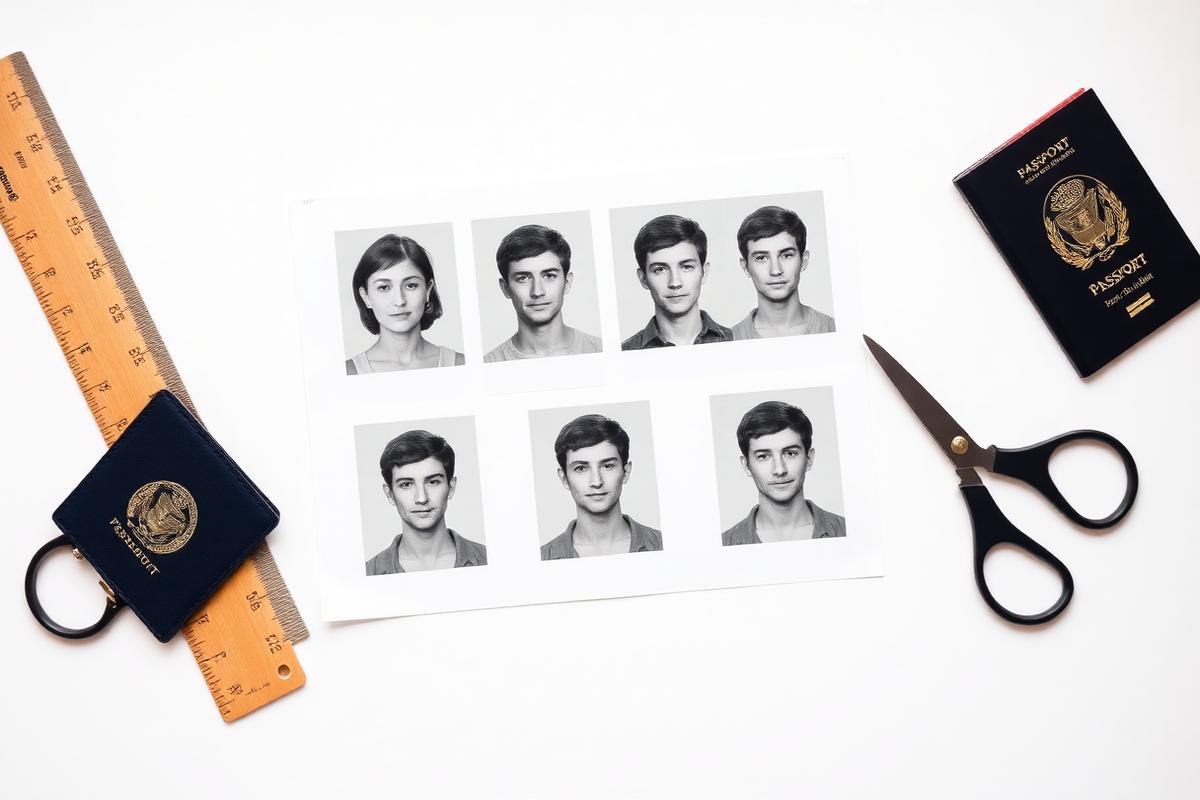
More entries are disqualified for photo problems than for any other single reason, and the disqualification is silent — you are not told, you simply never appear as selected. The DV Lottery photo requirements are strict and mechanical:
- Square aspect ratio — equal height and width, between 600×600 and 1200×1200 pixels
- JPEG format, file size no larger than 240 KB, 24-bit colour
- Taken within the last six months, and different from the photo used in any previous entry
- Plain white or off-white background with no shadows, patterns or objects
- Full face directed at the camera, eyes open, neutral expression, both ears and the hairline visible
- Head (chin to crown) occupying roughly 50–69% of the image height
- No eyeglasses of any kind, no sunglasses, no headphones
- No hats or head coverings except those worn daily for religious reasons, and the full face must remain visible
- No uniforms, and no heavy digital retouching or filters
- A separate compliant photo for your spouse and each listed child

Create a compliant United States · DV Lottery 2027 photo with ImageGates
Before you submit, make sure your photo meets the official specification: 2×2 inches (51×51 mm), white background, 600×600–1200×1200 px for online entries. ImageGates crops, resizes and formats your photo to the exact requirement in seconds — no photo studio appointment needed.
- Exact size & head position
- Background & file-size fixes
- Print & digital-upload ready
ImageGates is a partner tool for creating passport and visa photos. We may earn a commission if you use it, at no additional cost to you.
The selection process and what happens next
Entries are validated, duplicates removed, and a computer draw is run separately within each of six geographic regions, with allocations weighted so that no single country receives more than 7% of the visas in a year. Your odds therefore depend heavily on your region: entrants from smaller-volume regions such as Oceania have historically enjoyed selection rates several times higher than entrants from Africa or Asia, where entry volumes are enormous.
If Entrant Status Check shows you as selected, you receive a case number that determines your place in the queue. You then file Form DS-260, the online immigrant visa application, for yourself and every accompanying family member. The Kentucky Consular Center reviews your DS-260 and supporting civil documents, and once your case number becomes current in the monthly Visa Bulletin, you are scheduled for an interview at a US embassy or consulate. Before the interview you complete a medical examination with an approved panel physician. At the interview a consular officer verifies your identity, your eligibility basis, your family relationships and your admissibility. If approved, your immigrant visa is issued, you pay the USCIS immigrant fee, travel to the United States within the visa's validity, and receive your green card by mail after admission.
The hard constraint is the fiscal year: every DV case must be issued by 30 September of the programme year. A visa number that is not used by that date is gone, with no extension and no appeal. This is why speed and document completeness matter more in DV cases than in almost any other immigration category.
DV-2027 timeline at a glance
| Stage | Typical timing |
|---|---|
| Official instructions published | Late September |
| Registration window open | Early October – early November (about 4 weeks) |
| Entrant Status Check results | From early May the following year |
| DS-260 submission and document collection | May onwards, immediately after selection |
| Interview scheduling as case numbers become current | October through September of the programme year |
| Medical examination | Two to six weeks before interview |
| Visa issuance | Days to weeks after a successful interview |
| Final deadline — all DV visas must be issued | 30 September of the programme year |
Map these stages against your own circumstances with the Timeline Planner, which works backwards from the fiscal-year deadline and tells you when each civil document, police certificate and medical appointment has to be started.
Common mistakes that disqualify entries
- Submitting more than one entry per person — an automatic disqualification, even if the duplicate was accidental
- Using a photo that is the wrong size, has a patterned background, or was reused from a previous year
- Omitting a spouse or a child, including children from a previous relationship or those living abroad
- Entering names in the wrong fields, so that surname and given names are reversed
- Declaring a country of eligibility you cannot justify under the cross-chargeability rules
- Claiming a high-school education that cannot be evidenced with a diploma and transcripts
- Claiming work experience in an occupation that does not meet the O*NET Job Zone 4/5 and SVP 7.0 threshold
- Losing the confirmation number, making it impossible to check the result
- Waiting for an email announcement that never comes and missing the status-check period
- Filing the DS-260 late, so the case number becomes current before documents are ready
The Risk Analyzer and Refusal Risk Analyzer were built for exactly these failure patterns: they score your profile against documented refusal grounds and tell you what to fix before you submit rather than after you are refused.
Scams to avoid
The Green Card Lottery attracts more fraud than any other immigration programme in the world, because the prize is enormous and the audience is global. Learn the four signatures of a DV scam:
- Any fee to enter. The US government never charges for an entry. Commercial sites that "submit on your behalf" charge for something that is free, and often submit a non-compliant entry.
- An email or WhatsApp message saying you won. Results are published only through Entrant Status Check. Every "congratulations" message asking for a wire transfer or gift cards is fraudulent.
- Requests to pay a "visa fee" in advance. All legitimate fees are paid to the consulate or the designated bank at the interview stage, never to an individual, agent or foreign account.
- Guaranteed-win offers. No agent, lawyer or website can improve your odds in a random draw. What legitimate help can do is make sure your entry is valid and your documents are complete.
EntryNest never submits entries on your behalf and never asks for government fees. We help you prepare, verify and track — the entry itself always goes through the official portal, by you, for free.
How EntryNest helps DV entrants win the paperwork
The lottery draw is luck. Everything after it is preparation, and preparation is where cases are actually lost. EntryNest Plus and Premium turn the DV process into a managed project instead of a scramble:
- Personalised eligibility analysis
Confirms whether you meet the country-of-birth and education/experience tests, and surfaces stronger US pathways if you do not.
- Document checklist
A country- and case-specific list of every civil document, translation and certification you will need.
- AI document review
Automated checks on every scan for legibility, expiry, missing pages and name mismatches.
- Timeline planner
A backwards-planned schedule anchored to the 30 September fiscal-year deadline.
- Application builder
Guided, field-by-field preparation of your DS-260 answers and supporting statements.
- Refusal risk analysis
Scores your profile against documented refusal grounds and gives concrete remediation steps.
Free members can screen their eligibility and read every guide. Plus unlocks the cost calculator, document checklist and timeline planning. Premium adds the visa match report, AI application builder, cover letter and SOP generation, refusal analysis and ongoing support through your interview.
Preparing for the move
Once your immigrant visa is issued you have a limited window — usually six months from the medical examination — to enter the United States. Many DV immigrants travel before their household ships, live between two countries for a period, or return home to wind up affairs. Medical treatment in the US is expensive from day one, and green-card holders are not automatically covered by any public scheme, so travel and relocation medical cover during that transition is worth arranging deliberately rather than by default.

Protect Your Trip with Travel Insurance
Travel insurance may help cover medical emergencies, trip interruptions, lost baggage, and other unexpected travel expenses while abroad.
- Medical emergencies
- Trip interruption
- Lost baggage
This page may contain affiliate links. We may earn a commission if you purchase through our partners at no additional cost to you.
Frequently asked questions
What is the DV Lottery 2027?
The DV Lottery 2027 (officially the Diversity Immigrant Visa Program, DV-2027) is the US government programme that makes up to 55,000 immigrant visas — green cards — available each year to nationals of countries with historically low rates of immigration to the United States. Entry is free and submitted online through the official Department of State portal.
Who is eligible for the Green Card Lottery 2027?
You must be a native of an eligible country and meet the education or work-experience requirement: either a completed high-school education (a full 12-year course of elementary and secondary education) or two years of qualifying work experience within the past five years in an occupation requiring at least two years of training or experience.
How much does it cost to enter the DV Lottery?
Entering the DV Lottery is completely free. There is no entry fee of any kind. Fees only apply after selection, at the immigrant visa interview stage (the DV processing fee, plus medical examination and document costs). Any website charging you to submit an entry is a commercial reseller, not the US government.
What are the DV Lottery photo requirements?
Your digital photo must be square (equal width and height), between 600×600 and 1200×1200 pixels, under 240 KB, in JPEG format, taken within the last six months, with a plain white or off-white background, full face directed at the camera, neutral expression, no glasses, and no headwear except for religious purposes worn daily.
When does the DV-2027 registration period open?
The Department of State typically opens the registration period in early October and keeps it open for roughly one month. Exact dates for DV-2027 are announced in the official programme instructions published on travel.state.gov each year — always confirm the current dates there before entering.
How will I know if I was selected in the DV Lottery?
There is no email or letter announcing selection. You must return to the Entrant Status Check page on the official site, enter your confirmation number, last name and year of birth, and read the result yourself. Selection results generally become available in the May following the registration period.
Does being selected guarantee a green card?
No. Selection only means you may proceed to apply. More entrants are selected than there are visas available, and visas are issued in rank order until the annual limit is reached. You must still complete the DS-260 immigrant visa application, pass the interview, medical examination and security checks, and be found admissible before your visa number becomes unavailable at the end of the fiscal year.
Can I submit more than one entry?
No. Submitting more than one entry per person in the same registration period disqualifies you automatically. A married couple may each submit one entry listing the other as a spouse, which effectively doubles the household's chance without breaking the rule.
Do I need to list my spouse and children?
Yes. You must list your spouse and every unmarried child under 21 — including stepchildren and legally adopted children — even if they do not live with you and even if they do not intend to immigrate. Omitting a family member is one of the most common causes of disqualification at the interview stage.
What happens if my passport expires before the interview?
You need a valid passport at the time of the immigrant visa interview, not at the time of entry. Renew early if your passport is close to expiry, because a delayed renewal can push you past the end of the fiscal year, after which your DV case can no longer be issued.