

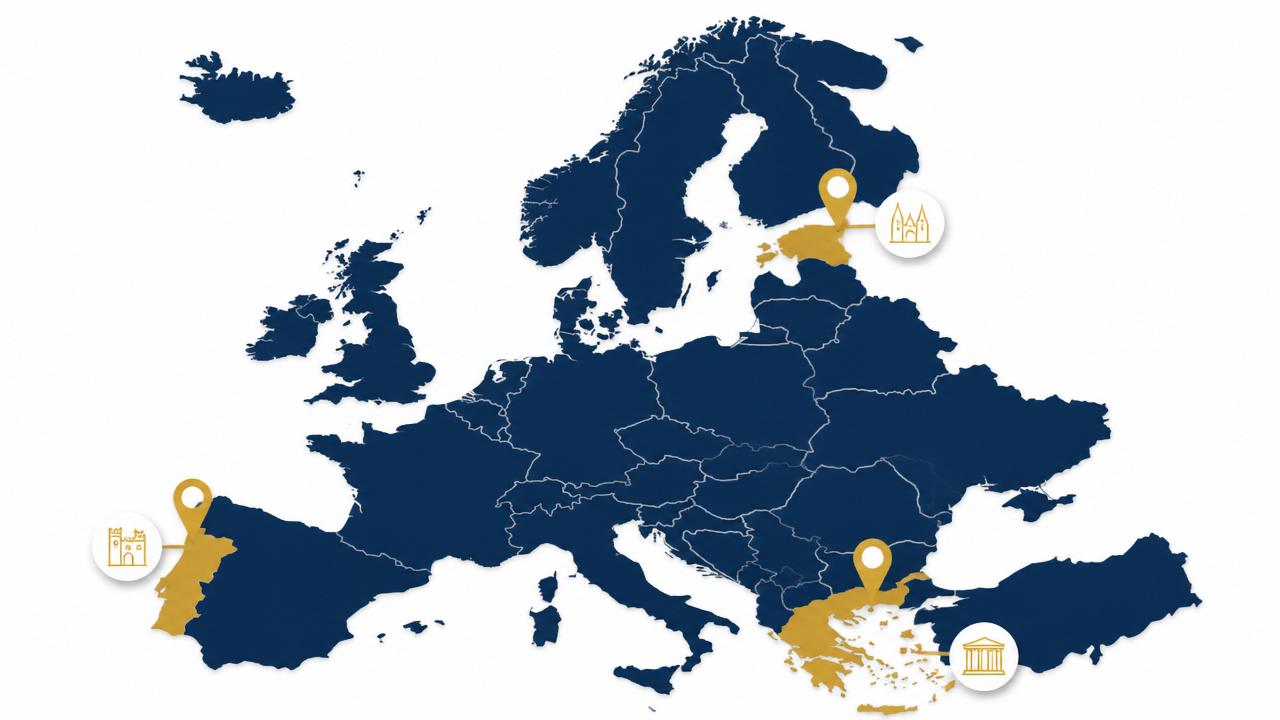
By 2026, more than fifteen EU and EEA states publish a digital nomad visa. Most of them, on paper, look interchangeable: prove remote income, prove health insurance, prove a clean record, get a one-year residence permit. In practice the four programs that absorb the majority of qualified applicants are Portugal's D8, Spain's DNV, Estonia's DNV, and Greece's DNV — and they behave very differently once you sit inside them.
The right choice depends less on income thresholds and more on what you want the visa to do for you: minimize tax, include family cleanly, lead to permanent residency, or simply give you a stable European base. This guide compares the four on the dimensions that actually drive that decision.
The side-by-side that matters
| Dimension | Portugal D8 | Spain DNV | Estonia DNV | Greece DNV |
|---|---|---|---|---|
| Income threshold (single) | ~€3,480 / mo (4× min wage) | ~€2,762 / mo (200% SMI) | €4,500 / mo gross | €3,500 / mo |
| Family uplift | +50% spouse, +25% child | +75% spouse, +25% child | Not included (separate permits) | +20% spouse, +15% child |
| Initial permit | 4 months → 2-year residence | 1 year → renewable 2 years | 1 year (max) | 1 year → renewable 2 years |
| Path to permanent residence | 5 years to PR / citizenship | 5 years PR, 10 years citizenship | Does not count toward PR | 5 years to long-term residence |
| Tax residency trigger | 183 days in PT | 183 days in ES | 183 days in EE | 183 days in GR |
| Special tax regime | NHR 2.0 (IFICI, narrow) | Beckham — 24% flat ≤€600k | Standard PIT 22% | 50% income exemption for 7 years |
| Allowed income source | Employment or self-employment, any source | Employment or self-employment (≤20% Spanish clients) | Foreign employer / clients only | Foreign employer / clients only |
Portugal D8: still strong, but no longer the obvious default
The D8 remains the most flexible structurally — it allows both employed and self-employed income from any country, has a clear 5-year path to PR and citizenship, and the application is processed at consulates with reasonable timelines. The complication is tax. The legacy Non-Habitual Resident regime closed to new applicants in 2024 and was replaced by the narrower IFICI (NHR 2.0), which targets researchers and qualified-occupation employees of certified Portuguese entities. Most remote workers fall under standard Portuguese PIT (progressive to 48%) once they cross 183 days.
Portugal still wins for candidates who: plan to settle long-term, want EU citizenship in 5 years, value the family inclusion structure, and are comfortable with standard Portuguese tax rates in exchange for residency optionality.
Spain DNV: the tax story is the headline
Spain's DNV has the lowest income threshold of the four (around €2,762/month) and pairs with the Beckham regime — a flat 24% tax on Spanish-source income up to €600,000, for up to six tax years. For high-earning remote workers this is the single most attractive tax outcome in Western Europe.
The constraint: no more than 20% of income can come from Spanish clients. Beckham eligibility is also strict — you can't have been Spanish tax resident in the previous five years. Family is included on the main applicant's permit, which simplifies the paperwork dramatically compared to country-by-country dependent applications elsewhere.
Estonia DNV: a clean residence card without a residency runway
Estonia's DNV is the most operationally elegant of the four. The threshold is high (€4,500/month gross, demonstrated over the prior six months), but the application is fully digital, decisions land in 30 days, and the country runs on e-residency infrastructure that makes opening accounts and operating a foreign business trivial.
The catch: the DNV is capped at one year total and does not count toward Estonian permanent residence. It is a base, not a runway. Family members apply separately. Use Estonia when you want a frictionless European base for 6–12 months while operating a foreign business — not when your goal is EU permanent residency.
Greece DNV: underrated, especially for families
Greece's DNV launched in late 2021 and has matured into the most family-friendly of the four. The threshold is moderate (€3,500/month, +20% spouse, +15% per child), and Greece's 7-year 50% income exemption for new tax residents creates an effective tax rate competitive with Spain's Beckham regime for many earners — without the €600,000 cap.
The DNV converts to long-term residence after five years and has a relatively forgiving renewal process. The trade-off is administrative friction: appointments at Greek consulates and AFM/AMKA registration in-country are slower than Spain or Portugal. Build in two months of buffer.
Five decisions that determine the right visa
1. Do you want EU citizenship eventually?
Portugal is the only one of the four with a credible 5-year citizenship runway under current rules. Spain takes 10 years (2 for Ibero-American nationals). Greece and Estonia don't lead to citizenship on these visas alone.
2. What's your effective tax rate at home today?
If you're a high-earning US/UK/CA software professional currently paying 35–50% effective tax, Spain's Beckham regime (flat 24%) or Greece's 50% exemption can save €30,000–€100,000 a year. If you're already under 25% effective tax, the tax dimension is a wash and family/PR factors should dominate.
3. Are you bringing a partner and kids?
Spain and Portugal include family on the main permit cleanly. Greece is workable but slower. Estonia treats each adult as a separate application and does not consolidate.
4. How long do you actually intend to stay?
Under 12 months: Estonia is the cleanest. 1–3 years: any of the four. 3+ years with PR ambition: Portugal, Spain, or Greece.
5. Where can your business legally operate?
If you have any Spanish clients beyond 20% of revenue, Spain's DNV won't fit. If your only employer is foreign and you don't want to incorporate locally, Estonia and Greece are simplest.
Three candidate scenarios
| Profile | Best fit | Why |
|---|---|---|
| Solo US contractor, $180k/yr, no kids, wants 5-year base | Spain DNV + Beckham | Threshold easily met, ~24% flat tax, family-friendly if life changes |
| UK couple + 2 kids, both remote, combined £140k/yr, want PR + citizenship | Portugal D8 | Family included, 5-year citizenship runway, lifestyle fit |
| Canadian SaaS founder, €200k/yr, wants 6–9 month base only | Estonia DNV | Fast digital application, no local tax entanglement, exit cleanly |
FAQ
Which digital nomad visa in Europe is easiest to get?▾
Spain has the lowest income threshold (~€2,762/month) and processes most applications in 20 working days. Estonia is the most digital and predictable, but the income threshold is the highest of the four (€4,500/month).
Do digital nomad visas lead to permanent residency?▾
Portugal, Spain, and Greece count time on the digital nomad visa toward 5 years for permanent residence. Estonia's DNV does not count toward Estonian PR.
Can I work for clients in the country where I hold the digital nomad visa?▾
Spain caps local-source income at 20% of total. Estonia and Greece prohibit local clients and local employer relationships. Portugal allows mixed income but local income becomes Portuguese-taxed once you're resident.
Will I pay tax in two countries?▾
Once you cross 183 days you are typically tax-resident in the new country. Double-tax treaties usually prevent double taxation but rarely eliminate it. Plan a tax-residency switch with a cross-border advisor before you move — not after.
Can my spouse work locally on my digital nomad permit?▾
In Spain and Portugal, dependents on the family permit can work locally. In Greece they can study and reside but employment rights are limited. In Estonia, the digital nomad permit does not include family — they apply on separate categories.
Do I need to rent or buy property to qualify?▾
None of the four require property ownership. All require proof of accommodation (rental agreement, hotel booking, or owned property) at the residence-card stage, not at the initial visa application.
What happens after one year — can I renew?▾
Spain and Greece renew for 2 years at a time, leading to 5 years total. Portugal's D8 converts to a 2-year residence card after the initial 4-month visa. Estonia's DNV is hard-capped at 1 year with no renewal — you must switch to a different residence basis to stay.
How does EntryNest compare these for me?▾
EntryNest scores each program against your real numbers — income, family, nationality, tax situation — and ranks them by approval probability and net financial outcome over 1, 3, and 5 years. It's the comparison you'd otherwise build manually in a spreadsheet, automated and kept current.
Next step
Compare digital nomad visas for your exact situation
Run your income, family, and timeline through EntryNest and get a ranked comparison of Portugal, Spain, Estonia, Greece — plus the eight other EU programs worth considering if your profile fits.
Built on EntryNest's eligibility engine
Every recommendation in this article ties back to the same rule engine that scores user profiles. Read our methodology, data sources, or trust center — or jump straight into the toolkit and pricing.

Protect Your Trip with Travel Insurance
Travel insurance may help cover medical emergencies, trip interruptions, lost baggage, and other unexpected travel expenses while abroad.
- Medical emergencies
- Trip interruption
- Lost baggage
Keep reading
Saudi Arabia Introduces New Travel Authorization Allowing UK Visitors to Stay Up to 180 Days
Saudi Arabia's new Electronic Travel Authorization lets eligible UK citizens make multiple visits and stay up to 180 days a year. Here's what changed and who qualifies.
CanadaCanada Express Entry 2026: how category-based draws rewrote the CRS playbook
A senior-analyst breakdown of category-based Express Entry draws, CRS strategy in 2026, and the profile moves that actually move the needle.